Monday, March 28, 2011

Yap, Federated States of Micronesia

I've gotten a bit behind on the blog, so let me first say that as many of you already know, we are currently in Palau (which was not affected in any way by the big earthquake in Japan - hooray!) We have been in Palau for about three weeks now. Fred flew back to Idaho a few days after we got here to take care of some business and do some skiing, so Jeff and I have been enjoying Palau on our own. We really like it here, but we also really liked Yap, so I wanted to put up this blog about our experiences there before I start writing about Palau.


Our time in Yap was pleasant right from the start. We arrived at entrance through the reef fairly late in the day, but the channel was very well marked, so we were able to head into the lagoon and get the anchor down well before dark. We weren't able to raise any authorities on the radio, but we were pretty tired after a seven day sail anyway, so it was kind of nice to not have to inflate the dinghy and go ashore to do the entry paperwork. Instead we got the lines straightened away and put the shade canvas up and toasted Yap from the cockpit. The Yap anchorage is very close to the local basketball court (which was a very nice facility with a roof and some bleachers), so we were able to see and hear some of the game that was in progress. Jeff was saying what torture that would be for Hughsie if he was on the boat - that he would probably try to swim and join the game, but we were all content to relax a bit and enjoy knowing we had a full night's sleep in a calm anchorage ahead of us.


The next morning one of the entry officials called us on the radio and we arranged to meet him ashore at 10 AM. He said he would come to the dock and show us the way to his office. He not only did that, but he also called all the other offcials we needed to see, and they all came to his office to sign us in. This was great, and is definitely not always the case. Sometimes Fred has to spend a couple hours walking all over town trying to find the various buildings for all the officials we need to see, and once he finds the right place he is often told that there is one particular person he needs to talk to who is out right then, so he'll need to come back later. So, having everyone meet us in one spot was great.


After doing the necessary paperwork, Fred needed to take the Quarantine officers out to the boat, but Jeff and I were allowed to wander about onshore while he did so. We noticed right away how clean Yap is, and that there were very nice roadside plantings, and lots of smiling faces. We found a fairly large grocery store near the anchorage and got directions to the ATM which we headed off for after meeting up with Fred who was finished with the officials by then. We were stopped on the corner by a slick looking young fellow who was flashing a map and saying something I didn't quite understand. It turned out that this guy was from the Visitors Bureau Information booth across the street and he was telling us about the free maps and brochures they had there. We got the maps along with a lot of genuinely enthusiastic information from this nice young fellow who we saw many times later and who always checked on us to make sure our visit was going well.


Next, on the way to the ATM we were greeted by another guy on the street who welcomed us to Yap and asked us where we were staying. I began to realize that Yap was small enough that the people who worked in town knew at a glance that we were new arrivals. We had a nice chat with Keyonei, during which he told us he worked at Trader's Ridge Dive Shop, which was across the street, and he invited us to stop by and check out the shop any time. Being strangers in a new place it's really nice to be greeted like this, and we definitely wanted to go diving, so we stopped into that dive shop later in the day and arranged to dive with them the next two days. After that we hit the internet cafe to check our shore emails and let everyone know we'd arrived safely. Fred liked the air conditioning in there so much that he got a hotel room for the night so he could enjoy more of it, and Jeff and I headed back to the boat to with a frozen DiGiorno's pizza. This was a big treat for us, since we find island pizza to be a different than we are used to, so this frozen one was the best we'd had in quite some time.


The next day we went diving. Vince and Keyonei brought the dive boat out to God Spede to pick us up. This is nice for us because otherwise we have to load all our dive gear into the dinghy then unload it again at the dock and then load it again into the dive boat. Yap is known for it's local Manta Ray population and quite a few of Yap's visitors are divers who stop here on there way to or from Palau. We had already done a couple Manta dives in Pohnpei, one where we saw no Mantas and one where we had a great experience with various sets of them swimming formations over our heads. They are quite big, and it is pretty cool when they swim above you becuase it looks a bit like they are flying over you, but the problem with Manta dives is that you often go to "cleaning stations" to see them, and if they aren't there, then your dive can be a bit dull. Cleaning stations are usually a clump of coral in the middle of a sandy channel which have cleaning wrasses living on them. Mantas or sometimes sharks or other big fish come to the stations to get cleaned by the wrasses. It's cool when something is there getting cleaned but there's often not much else to see if nobody is home.

Manta and Reef


Our first Yap dive was to a very shallow cleaning station, but we were lucky in that there were lots of Mantas there that day. We hooked into the reef using reef hooks, so I had both hands free to operate the camera and try to get some good shots. We stayed for about 20 minutes watching the mantas swim about. It was really nice.

Manta overhead


Our second Yap dive was to a site called Vertigo, where we were told there were lots of sharks and big snapper. They weren't joking!

Lots of sharks!
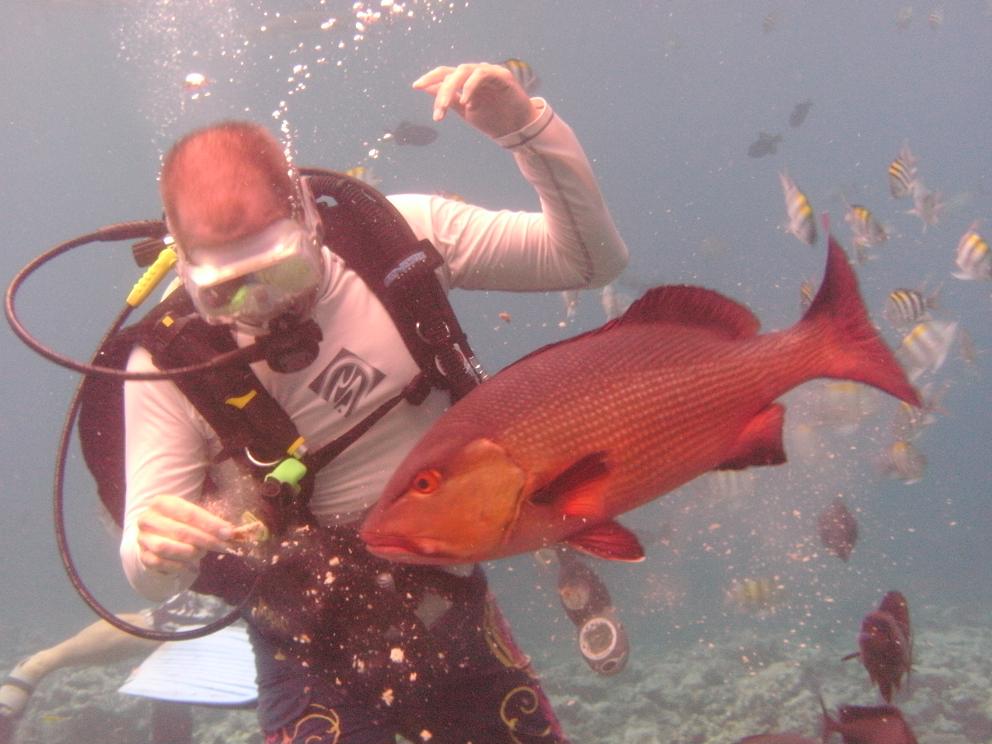
I don't think I'd ever seen so many sharks at once unless the dive guides were feeding them. We found out later that they do feed them at this spot some days, but not the day we were there, although they did tell Fred to take some bread that was leftover from lunch with him to feed the snapper. Apparently snapper love banana bread - go figure!

Fred feeding snapper
The snapper were all around us the minute we got in the water. We started in about thirty feet of water near the edge of the reef and then swam to the drop off where there were a lot of sharks circling around. We just floated there and watched them swim around and around.

Black Tip Reef Shark
Some were small reef sharks, but there were lots of grey sharks as well, which are a bit bigger. I'll admit here that I mostly enjoy seeeing sharks while we are diving, they look so powerful and sleek, but it still raises my hackles a bit when there are a lot around at once. I can't help thinking that if just one bit you that the blood would have the rest of them on you in a flash. Jeff always tells me that the dive companies would be out of business quick if their customers were getting eaten by sharks, and I know it's true, but that doesn't prevent the heebie jeebies from setting in, particularly if I look back and find that one has circled around behind us. I would really prefer if they would all stay front and center where I can keep an eye on them. After watching the sharks for a bit we swam along the outside of the reef and saw some great coral and a turtle. It was a great day of diving.

Grey Shark


Turtle


Our second day of diving in Yap was also nice, but not quite as good as the first. We went outside the reef to the southern point and dove Yap caverns first. There was some really nice coral here and a lot of bumphead parrotfish, but the visibility was not so great so it was hard to appreciate the big picture. Our guide, Barnaby, made up for that by pointing out lots of "macro critters" to us along the way. ("Macro critters" is cool diver slang for the little bitty creatures that it's very easy to overlook.) We saw two leaf fish (the first I've ever seen), some micro crabs, a lionfish and a moray eel. When we got back to the surface a big black cloud was headed our way and Vince decided that we needed to get back inside the lagoon before it arrived, so we went around the west side and headed for another Manta dive spot. We were not so lucky with the Mantas that day, but we did see a couple eagle rays and Vince showed us some underwater stone money and took our picture with it.

Underwater with Stone Money


The stone money, as far as I know, is unique to Yap. It's not in use anywhere else in Micronesia. It really is stone, and it really is money, and it's still in use today. Basically it is big pieces of some kind of rock that is not found on Yap. All the stone money in Yap was brought over from Palau. Most of the stone money we saw looked just like a stone wheel in a caveman cartoon. It's round with a hole in the middle that you can put a big stick through so about eight men can carry the money around. I think there are also some bigger pieces, but we never saw any of those. Traditionally, it wasn't moved very much once it was brought over from Palau. Bigger doesn't necessarily mean it's worth more. What gives a stone it's value is the story of it's history including the tale of the journey over from Palau. Apparently, the rougher the journey, and the more people who died on it, the more the stone is worth. Stones that were gathered later, using tools and bigger ships, are not worth as much as the ones from earlier times that were carved by hand.


Most of the stone money that we saw was near the "Men's houses", which are big, rectangular roofed spaces where the men gather for important meetings or ceremonies. The more important men get the better, higher seats, and then there are lower levels for the less important guys, and a seperate space entirely for the ladies. I assume that the money originally got put in front of the house of the village that owned it, but we were told that it doesn't often get moved, even when it's traded to another village it stays put and everyone knows who owns each piece of money.


I have to admit, that my first thought on seeing this stone money was "Hello - that's not money, that's just a piece of rock!" Then later the same day I was buying some stuff in the grocery store and I looked at the fancy paper I was paying with, and I thought, hmmm, I suppose some alien could say, "Hey lady, that's not money, that's just a piece of paper". Then I remembered that our paper currency is backed up by gold, and I felt better until I realized that "hello - gold is just a piece of yellow metal!" Then I started wondering how "money" really works, and then I decided that that wasn't what I wanted to think about just then, so I decided to forget about it and just stop poo-poohing the stone money. It did also occur to me that security-wise the stone money concept is superior - it's quite difficult to move, and the stone itself isn't worth anything without it's story (although it's not clear to me why a thief couldn't just make one up).


I learned most of what I know about stone money the day we did a land tour with Vince. We drove around most of the island with him and he answered lots of our questions about Yap and it's customs. He also showed us his wife's village (he married a mainland Yapese woman) and the plot of land where one day they hope to rebuild the house her family once had there that was completely destroyed by a typhoon. Only the foundation and the betel nut trees remained. As a bonus on our tour we got to see Vince cut some of the betel nuts by tying his knife onto the end of a long branch using a leaf he cut into strips, and then raising the knife up on the branch and chopping off a clump of betel nuts from the top of the tall skinny palms they grow on. Cool.


The next day we went out fishing and spearfishing with Keyonei and Barnaby. We took our spear gun out too and Fred got some pointers from Keyonei who is an amazing spearfisherman. Apparently spearfishing is easy if you are able to free dive to about 40 feet and stay down there for a good long time. This is apparently not a problem for Keyonei, who comes from one of Yap's outer atolls where fishing and spearfishing are the daily activities for the boys and men. The ladies take care of the farming and cooking. We were told that almost all the dive guides on Yap proper were originally from the outer islands, where free diving is a way of life. Keyonei was able to fill a cooler full of fish pretty easily, and although we didn't have any luck spearfishing, we did catch a mahi mahi while trolling along the outer reef on our way to the spearfishing spot. We were pretty excited since this is the first mahi mahi we have caught on this entire trip, but unfortunately I managed to lose the picture of it and all the other Yap onland pictures we took while we were there. Bummer. We did, however, enjoy a magnificent fish dinner that night!


We also had a bit of excitement after the spearfishing when Keyonei told us that he didn't want to go all the way back to the pass to get back into the lagoon, so instead we would go over a low part in the reef, which would only work if we rode in over the reef on the right size wave. Apparently there is no pass into the lagoon around the island where Keyonei is from, so they take small boats over their reef frequently and it's just a matter of counting the waves correctly - which all sounded nice and reassuring until we got real close to the reef and he put his in shoes on "just in case". Then he told us to look around the boat and make sure everything was secure because there was a small chance we could capsize. Well, I'm not sure what Keyonei's definition of "secure" is, but as far as I could tell nothing in the boat was secure. We had fins and masks and snorkels and spearguns laying everywhere. The fish was all in the cooler, but the cooler itself was in no way secure. In fact, I'm not sure how we could have made anything secure, it was a small, open boat without compartments to put things in. I suppose we could have at least put our snorkel gear back in it's bag (the bag with the broken zipper) but although Keyonei said to make things secure, I couldn't see how, and he and Barnaby didn't seem to be securing anything, so I just grabbed the new camera and put it's strap around my wrist and decided to hope for the best. We made a couple big circles in silence - I was afraid to say anything since I didn't want to interupt Keyonei's concentration. Barnaby was in the bow and I kept my eye on him. He didn't look nervous, but he did look intent. Then, we finally caught a wave and zoomed over the reef with no mishaps and everyone relaxed and started joking again, so I assumed we were safe.


We thought we would be leaving the next day, but the weather simply did not cooperate, so we stayed a few more days and got to go to Yap Days, which is a yearly celebration of traditional Yap culture that includes dancing, and stone money carrying contests among other things. Most people there were in traditional garb which includes colorful skirts for the ladies and loin cloths for the men. Some of the loin cloths were topped with some unique straw looking decorations that are made from hibiscus bark. It was all very interesting to see, although unfortunately they ran out of programs before we got there, so we didn't really understand what any of the songs were about.


One of the my favorite things about Yap, were the very interesting people we met there. For instance, We met Chief Munno one day as we were returning to the boat after Yap Days. He was walking down the street wearing only a blue loincloth and carrying the tradtional men's woven straw bag. He hailed us from across the street, and when we crossed he introduced himself and asked where we were from, and if we had been enjoying our stay in Yap. (It seemed like the majority of people we talked to really wanted to know if were having a nice visit.) I assumed, based on his attire, that he had been to Yap days, but as we chatted we learned he was the chief of one of the outer islands who was on the main island to attend a Chief's conference. The goverment of Yap has four main branches, the same three we have in the US plus a group consisting of the chiefs which includes the chiefs of the outer islands along with those from Yap proper. Anyway, Chief Munno was very interested to learn that we were from Idaho. Seems he had gone to college in Eastern Oregon and had fond memories of a road trip to Boise (to buy some Coors beer!) Chief Munno went on to tell us that he is only a few credits away from a Masters degree, but he missed home to much, so he came back before finishing. He was a fascinating fellow, and we exchanged email addresses with him, but he also requested our postal address because when he is back home on his island he does not have access to "those machines". Given that the Yap government is clearly very vested in the country's infrastructure, I assume this is by design. I assume that they could have internet on the outer islands but that they sometimes choose not to, because I know that one of Yap's stated goals is to try to keep traditional living alive, while also attempting to make themselves economically viable by developing their tourist industry. It seems like a very tough line to walk, but I hope they can do it, because Yap is definitely a very unique place.


Another day, in the laundromat I met two other interesting characters. The first was a very nice 75 year old lady who very kindly offered to share her lunch with me. She has six grown children, and many of them went to college in the US, and a few of them still live there. She's been to visit so many times that she is bored with their hometowns and on her last visit she asked them to take her to Las Vegas where she won either $900 playing the slot machines. The other character was a gentleman who was dressed in a loincloth and carrying a woven straw bag full of betel nuts. He was waiting in the laundromat for a ride back to his village, where he owned a small store. He asked me about the book I was reading, and wheter we read a lot on the sailboat, and told me he had just finished reading the Bill Clinton's autobiography. Somehow this was just not what I expected him to say, but it was great chatting with him.


People here in Palau keep asking us what there is to do in Yap, and my advice is to just wander around town and chat with the very friendly people there. It really is a unique, and very lovely experience.

Tuesday, March 1, 2011

Truk Lagoon (Chuuk), Federated States of Micronesia

Truk Lagoon islands and dive boat

Truk Lagoon is the first place we've been to that we were warned repeatedly about before arriving, but we are happy to report that we had no unpleasant incidents during our stay there. We were very careful while we were there, especially since we continued to be warned by locals that everything on deck should be locked up, and we purposely anchored in only one location, which was off of the lovely and welcoming Blue Lagoon Resort, and we limited our overall stay and severely limited our time in the main town, and although it's a shame that we felt that all of this was necessary, I am glad to say that we had nothing but pleasant experiences during our stay in Truk.


We arrived to the main town dock pretty late in the afternoon our first day here after motoring twelve miles inside the reef. The lagoon here is huge. It's quite different from Pohnpei, which was basically one large mountainous island with a nearby fringing reef. In Truk their are many medium to small islands which are all surrounded by a reef which is ten to fifteen miles away from the central islands. The town of Weno is where we had to go to check into the country, and is also where we had been told that fights often break out in the streets between local youths.


We reached the main town dock at about 2:30 PM. This dock is really designed for much bigger ships with huge bollards spaced quite a ways apart. We put our bow line around one, but the next one back was quite a ways away, so Jeff volunteered to stand on the dock and hold the stern line. Unfortunately for him our check in process was delayed while we were waiting for one of the agents to show up, so he wound up holding the sailboat onto the dock for about two hours while many of the local skiffs went flying by creating totally unneccessary wakes to push us around. It was a bit annoying, but eventually we got our paperwork in order and still had enough daylight to head south to what we had been told was a much safer anchorage off of the Blue Lagoon Resort. We got the anchor down and got the dinghy inflated in record time and went ashore to arrange our diving for the next day. Then we headed back to the boat to finish our post-passage necessary chores and make ourselves some dinner and hit our bunks for that first blissful night of uninterrupted sleep.


The next day was the first of four days of fantastic wreck diving. We'd heard that Truk is in a class by itself when it comes to wreck diving and I think we are all now believers. We went ashore a few minutes before what we thought was 9 AM, the time we were meant to meet our guide on the dock. We waited and waited and made a few jokes about island time and waited some more, and Jeff finally walked up to the dive shop to make sure they knew we were there. In the meantime a nice fellow came over and began chatting with Fred and I. He asked if we were going diving and mentioned how early we were. Once again we had crossed into a new time zone during the passage without realizing it and we were an hour early. Sheesh!


A few minutes later, Estos and Mack brought the boat around and we loaded up our gear (after apologizing for rushing them!) and met a father and son from Australia who dove with us for two days, and headed out over some very calm water between some very beautiful islands to our first Truk wreck.


The Fujikawa Maru was a 433 ft Japanese aircraft carrier. We swam along the outside for a bit and admired the amazing hard and soft corals which almost completely cover the outside of the boat. It makes the boat itself like a reef and makes swimming around all the masts and the towers that stick up from the deck really interesting. Just the outside would have been an amazing dive, but Estos led us inside to a room with lots of pipes and some electrical circuits still showing. We swam around this for a bit then went swimming through to the holds. There were six holds on this boat all with something cool to see, but my favorites were the ones with containing the Japenese Zeros. It was unbelievably cool to be swimming around inside a ship under the water and see these planes inside. One of the holds had about six of them and they were scattered around and kind of lying on top of each other. It was amazing how tiny these planes were. I could not imagine getting in something that size and going to shoot at other planes and ships. Incredible. The holds also contained many fuel drums, lots of saki bottles, some gas masks and some shoes.

A few of the MANY saki bottles we saw while diving


Our second wreck the first day was the Heian Maru, a 510 ft submarine tender with more amazing coral outside and a really cool very long horizontal swim through with periscope repair pieces laying in the hallway.


I was completely sold on Truk wreck diving after these two dives. We all agreed that we could easily do mulitple additional dives on these two wrecks before their charms would begin to pale.


The second day we went first to the Shinokoku Maru, a 500 ft naval tanker, whose superstructure was covered with gorgeous coral. Even the bow gun was covered, so much so that it took me a moment to understand what I was seeing. We also swam inside and saw an operating table and a side room with a tiled tub.

Jeff amongst Shinokuku superstructure


This was also the first dive that we took our amazing new underwater camera on. This camera was a Christmas/Birthday/Easter/Valentines/St Patricks Day/Thanksgiving present from Judy and Merv, and we were super excited to try it out! We are also super excited to be able to share our underwater experiences on the blog thanks to the photos from the new camera. Jeff and Fred were a bit amused at the fact that I read every word of the instructions beforehand and at my initial nervousness about damaging the camera, since Jeff graciously allowed me to have the first go with it. It took a bit of getting used to at first (I am definitely NOT a "gear girl" and there is already a lot going on when you're wreck diving) but then I was very pleasantly surprised at how much fun it was to take some outside snaps. We didn't attempt any inside photos at this point, because it's pretty dark inside the wrecks and some of the spaces are pretty small and there are sometimes sharp pieces of metal about, so you need to pay attention to where you are, but we made up for it once we were outside the wrecks back in the better light. We took a gazillion photos and you can be assured that from now on we'll be posting pics of all our dives.

Coral on the Kensho


Our second dive this day was the Yamigiri Maru. It had a big torpedo hole in side which we swam into, and more amazing coral on the outside, and also a human skull which appeared to be fused into the wall of the engine room. This was the only sign of human remains that we saw while diving although many of the wrecks have them. Our dive guide told us before the dive that it was there and gave us the option of seeing it or not. We voted to see it, and to me it seemed a good reminder that we were actually diving on ships that were sunk full of men during a war. It's easy to lose track of that while gawking at the amazing underwater sights.

coral on the Yamagiri


The next day our first dive was on the Nippo Maru, a 351 ft cargo ship which had a one man tank sitting on one of it's decks. Again, I was surprised at how small the tank was - tiny! I can't imagine getting into something like that by yourself and driving around these islands with people shooting at you. Crazy! There were also som artillery guns on wheels deck on the deck. For some reason (maybe because of the wheels?) these looked to me more like something from the Civil War than from WWII. There were also a lot of big, square water tanks in one of the holds and tons of saki bottles.


There were actually tons and tons of saki bottles in every wreck we saw. So many that Jeff now has a theory that Saki consumption may be a major factor in why the Japanese lost the war! It may sound silly reading this at home, but if you come take a look at these wrecks I guarantee you'll think he's on to something!


Our second dive that day was the Kensho Maru, a 381 ft cargo ship. In this ship Estos took us through some really amazing swim throughs. We went up and down some very skinny staircases, and since this boat is sitting right side up it felt like you were walking around in it. We went to the engine room where there were plenty of levers still intact. There was also some really nice coral on the bow gun outside.

Kensho coral encrusted bow gun


Our first dive on our fourth and last day of diving was on the San Francisco Maru. This was our deepest dive in Truk with a max depth of 165 feet. We dropped down near the bow of the boat which is the shallowest part of this wreck, but still deeper than the deepest parts of the other dives we had done. There was very little coral here, compared to the other dives we had done (I think because it is so much deeper, but didn't get that confirmed by Estos), so we got a really good look at the bow gun and the track that it spins on. Next we swam over to see the two one-man tanks that are on the starboard deck. One tank was partly on top of the other - it sort of looked like they had collided and one tank went up over the other, I imagine this happened either when the ship was being bombed or when it hit the bottom. There were some china cups and plates from the wreck displayed near the tanks also. There was another tank that we saw on the port side of the boat. Between these there were some deeper, open holds where we could see the skeletons of trucks including the chassis, steering wheel, and seat frames. All of this was in front of the bridge and when we reached that we turned around and began ascending gradually back towards the bow and the mooring line to the dive boat. This had all taken only about 15 minutes, but we needed to head back up while we still had plenty of air for the decompression stops diving at this depth would require. There wasn't much to look at on the way up, and we had to spend a good bit of time there, which is the problem with deep dives. I'm glad that most of our dives weren't this deep, but I really enjoyed this one all the same. Seeing the tanks sitting there on the decks was really neat, and seeing this one boat with so much less coral growth than the others was interesting also.

Betty Bomber engine


After a fairly long surface interval, which we spent back at the resort itself, we went back out for our final Truk dive at the "Betty Bomber", a Japanese plane which came down just a little short of a runway that had been built by the Japanese on one of the flatter islands. This plane is in fairly shallow water. It's engine of the plane is about a hundred feet away and we swam over to check that out first, then back to the body of the plane itself.


Fred coming out of the Betty Bomber

The nose was sheared off of the the body, so you could look right inside from the front. There were a gazillion little fish inside, and when I swam in they just moved over a bit to let me through. It felt a little like swimming inside an aquarium. I enjoyed it so much I went through a couple times going each way. Scattered about on the ground outside the plane were some radio parts, oxygen bottles, the ever prolific saki bottles, and a gun that looked more like a hunk of rusty metal than anything else.


Fred with the gun from the Betty Bomber


We had originally planned on four days of diving while in Truk, but we were having so much fun that we would have added a few more days, especially since the weather did not allow us to leave right away anyway, but unfortunately Fred and Jeff both had their ear infections recur, and I managed to really smash my foot on a piece of deck hardware, so we sat around a played hospital boat for the next day or two before checking out on Monday. The guys did make one short provisioning run into town, and said that it was every bit as bad as it was reported to be. I can't tell you how many people in Pohnpei described it as "a shithole". Multiple people used that exact phrase, and not all were the sort of people you'd expect that kind of language from. The boys agreed, however we also all agree that the Blue Lagoon Resort is quite nice. They have lots of security and very friendly staff in general, so if you want to dive in Truk, our recommendation is do it, but definitely stay at the Blue Lagoon.


We had to go back to the town dock again to check out of the country, then we headed north and got through the pass out of the reef a few hours later to begin our 800 mile sail to Yap.

Saturday, January 29, 2011

Pohnpei, Federated States of Micronesia

January 30, 2011

We've been in Pohnpei for about three weeks now, and, as always, there are things we like quite a bit about this place, and things that are not ideal. The biggest bonus of all has been that we've been able to get the refrigerator repaired here. It had been acting up for quite awhile, but finally decided to quit completely just as we pulled into the harbour here. Obviously having anything as important as the box that keeps the wine cold die on you is a big problem, we were grateful that the fridge waited till we got here to die completely. There was definitely no way to fix it in the Solomon Islands and having it die mid-passage would really be depressing. Luckily for us, here in Pohnpei there are both hardware stores that stock the freon we need and a knowledgeable and friendly man with the gauges you need to put the freon in, and US mail delivery here so that we could get the new compressor in a timely manner and without spending an extra fortune to have it shipped here. All of this is made a bad situation much better than it could have been, but a broken fridge is still a bad situation. However, the new fridge has been in for about a week and is working great and seems to be using a lot less power than the old one was, which is no big surprise since it was running full out full time towards the end.


Pohnpei is a fairly large, mountainous island with a surrounding reef. The reef is a few miles out from the shore in some places and is fairly deep, but also has little mini reefs and some small islands sprinkled around inside it. The good part about this is that the harbor is very sheltered and you can motor around inside the reef and be in pretty protected waters. The bad bit is that the big island does not have hardly any beaches, it has lots of mangrove fringed areas. Here the lack of beaches doesn't just mean no good sunbathing it also means not being able to swim from shore in many places, so although there is great snorkeling and diving out on the reefs you need a boat to get there. For us it means that although we can swim off the boat (something we've been really looking forward to since the Solomon Islands!) we can't see the bottom and there is no nearby snorkeling. But the harbor is very protected and quite calm even when the many rain storms through.

Row of wrecks


The harbor is also home to a lot of abandoned, large commercial vessels in various stages of sinking.  Most of them appear to be way more recent than the WWII.  I don't quite understand why there are so many here, or conversely why there aren't so many other places, but we have taken to joking calling Pohnpei the wreck snorkelers paradise. 

An older wreck


Other aspects that affect a cruisers daily life are that the town is not right on the harbor waterfront. To reach the town from the boat we take the dinghy over to an abandoned dock which is in a very advanced state of disrepair. So much so, that despite our best precautions Fred broke through the dock one day and fell right into the water. Luckily he was not hurt, it was a short fall into a shallow water with a mud bottom, but it certainly could have been bad. It was a rotten four by four beam holding up the outer edge of the dock that broke beneath him. Yikes. After we carefully tie up the dinghy to the dock we walk up a very steep, but thankfully short hill to the Ocean View hotel. This hotel is a boon to cruisers since the have a bar and restaurant, very reasonably priced wifi, and Satellite TV with a live ESPN feed, much to the delight of the sports lovers.

Pohnpei anchorage - Ocean View hotel is the big building on the hill


From the Ocean View Hotel it is a fairly short walk to the near part of town, but a fairly long walk to the far side of town. Taxis are very inexpensive here and we used them a lot. Frankie, our favorite taxi driver, had his birthday while we were here, so we gave him a Wise Guy's shirt to remember us by.

Fred and Frankie


Other good things about Pohnpei - did you catch the part where I said there was a hardware store here? Well, actually there are two, an Ace and a True Value AND a Napa Auto parts. The hardware stores are both huge, and it's not an exaggeration to say that I walked the aisles drooling for about five minutes on my first visit there. We've not seen anything like this on the boat since New Zealand.


There are also a couple good supermarkets here, and they are stocked with products from the US. We are seeing BBQ sauce, canned chili and pickles for the first time in a long, long time. It's funny how exciting that is. So much of the food that is available to us is the same thing over and over again that any variation becomes a pretty big deal. Ever since we've left New Zealand all the countries we've been in have been supplied with either New Zealand or Australian products, and although many things are the same, many things are also just not available. Dill pickles are a big deal. In New Zealand they mostly have gherkins and since then we've seen only gherkins, but mostly no pickles at all. That's just not right.


The downside of the food being from the US is that the US is pretty far away, so many of the products are right at or past their expiration dates. Many stores have a shelf rack marked "Animal Feed" which is where they put the far out of date items and sell them for 50% or less. This may partially explain why the pigs here are so big. And, no, we didn't visit a farm to see a pig, Jeff and I saw one pass in town in the trunk of a small car. A really big pig in the trunk of a small four door car. It's legs were tied around a big stick and it's head was kind of sticking out the side because it was too big to fit down in the trunk. Fred also saw one being carried through town by two guys at either end of the stick. Apparently they like a good pig feast here in Pohnpei, and I certainly don't blame them!


Another interesting thing about food here is that every restaurant we've been to has sashimi on the menu. This includes the fancy places and the fast food joints. For example Arnold's, which was recommended to us by many locals, looks like your typical low budget strip mall eatery in the US and has a really good cheese steak sandwich, pizza, hot wings, salads - and sashimi. And the sashimi is delicious. There aren't different choices, it's whatever kind of tuna they got that day served very simply with soy sauce and wasabi on the side, or local style with ginger and lime. It's almost always one of the best things we get at any restaurant which surprises me again and again. It just seems so unusual to be getting sushi at the local burger joint and loving it.

The reason for all the US stuff is that Pohnpei, and all of Micronesia (formerly known as the Caroline Islands), has been closely associated with the US since the end of WWII. Sometime in the 1880s Pohnpei was claimed by Spain who then ceded it to Germany as part of the deals at the end of the Spanish American War. Then Japan took over at the beginning of WWI and was later awarded trustee ship of the islands after the war by the League of Nations with the caveat that they not build military bases or attempt to colonize the islands. However, there was apparently no oversight of this arrangement, and sometime before WWII Japan pulled out of the UN and still nobody thought to revoke their control over these islands, so Japan went right ahead and built a huge military base on Truk (which is west of Pohnpei, and where we are headed next). So, after WWII the US took control when the Japanese surrendered to us and later the US was given the protectorship of the islands. Pohnpei, Truk, Kosrae and Yap have since banded together and formed the Federated States of Micronesia, which still maintains close ties with the US. I mention all this here because it was all news to me when we got here. I knew the US had ties with Guam, but I knew nothing about FSM.


For today's visitor to Pohnpei what all this means is that the ATM gives you US cash, the cars and you meet a lot of Americans here. They are mostly employed as teachers in the college or work for groups who oversee the large sums of money this area receives via various charitable organizations. Most of them arrived here on an airplane, but there are a few folks here taking a break from cruising and living on their boats in the harbor while stopping here to work for awhile. We've also met a crazy irish/english couple Noel and Kathy. Kathy is teaching at the college while Noel is working on the boat. Noel qualifies as the very first person we met here since he was kind enough to call us on the radio when he saw us coming in to share some local knowledge. He also rowed over soon after we got our anchor down and became the first local member of our arrival celebration. Next, Glen, an American here on a sort of outrigger style catamaran that he built himself came over to say hello, then Noel went back to his boat and got Kathy and some homemade beer he had onboard, and we contributed the SolBrews we had brought from the Solomon Islands, and we had a real party on our hands. Very nice to have a warm welcome!


The next day we met John and Jean. They are teachers who have taught at many overseas locations, the last being in Trinidad. When they decided to move here John flew back and sailed their boat from Trinidad to here, so they have first hand knowledge of some of the trials of the cruising sailor like lack of local knowledge and a very limited supply of fresh water. They have been extremely kind to us during our stay here and have taken us diving and hiking and helped us with our mail and pointed us to Peter, a New Zealander who works here also, who has helped us with lots of repairs and driven Fred to the hardware store about a hundred times to get supplies. Big thanks to John, Jean and Peter!


Our first couple dive outings here were with John and some friends of his. They often go out on Saturdays with Anchur, a local business man who enjoys fishing and has the typical local style boat here which is a long open outboard style boat. We went out two Saturdays in a row with these guys and it was fun to meet everyone on the boat and a nice relaxed way to do some diving as well. We dove two different spots each day, usually in one of the passes through the outer reef. So first we'd zoom out about five to ten miles in the boat to the first spot, then try to figure out which way the current was going through the pass, and go to the correct end so we could drift down with it. Unfortunately, we weren't always quite right about which way it was going, so we would sometimes turn around and not go in the planned direction, but Anchur always found us at the end of the dive, so that was OK. It's amazing to see underwater the passes that you are taking the boat through. Very reassuring here because the walls of the passes really go almost straight down. The coral itself is not nearly as impressive here as some other places we have been, but we've really been to some amazing places and may just be getting quite spoiled. We did see a couple small reef sharks on our first dive here and on the second saw some very large schools of fish. After the first dive each day we'd get our gear off and have some lunch while Anchur did some snorkeling, and then zoom over to the next dive spot, dive there and then zoom home again at the end of the day. On the first day the tide was high enough that we got to come back through a mangrove passage between the main island and a smaller one. The mangroves met overhead and it was like being in a tunnel for quite a long way. Very beautiful.

Traveling through the mangroves on the dive boat


We also did a couple days of diving with the only commercial dive shop on Pohnpei which runs out of the village Hotel. We had been told by many people that they were quite expensive, and I suppose that compared with going to Anchur it is expensive, but we thought it was well within the normal range of pricing for a commercial dive shop (the cost does vary quite a bit from place to place). We did one day of diving with them in the Pohnpei lagoon one stop of which was at Manta Rhodes where we were really close to some very large manta rays, some of which were stopped at cleaning stations and some of which were swimming around in a line of four doing "formations". It was amazing.


Our second day of diving with the Village was at Ant Atoll, which is about 10 miles outside the reef to the west of Pohnpei. This atoll has a very skinny but long and winding pass entrance to it and we dove both sides of it the day we were there. We saw a lot of reef sharks here as well along with a really big school of bumphead parrot fish. Getting out to Ant was a nice treat for us because we wanted to take the sailboat out there as well eventually, and this way we got a closeup preview of the pass from someone else's boat, which is a big plus.
Dive boat at Ant Atoll


But I think my favorite part of diving with the Village was meeting Martin Reiser, a delightful guy from Germany who has taken a year off from work and is traveling around diving. Martin was great to chat with in general, and, another bonus for us personally, he has done a LOT of diving in Palau, one of the places that is in our future, and had great things to say about it and gave us lots of tips for our visit there. We had dinner with Martin after our second day of diving with him and he has a picture of us up on his website along with great photographs and video from many of the dives he has done.

View from the Village Hotel dining room


A couple days after going with the dive guys to Ant we took God Spede there and anchored out for three glorious days. Ant atoll is currently uninhabited. It is a ring of coral with a couple long skinny islands on part of the ring and a big, deep lagoon within. We were the only boat anchored there, so we were the only ones there at night, but the Village Hotel's dive boat came out one day and another small boat was there another day, presumably for fishing. We took the dinghy over to the pass each day and did a lot of snorkeling. The visibility really varied at different parts of the pass each day, but there was one little cove where we could always clearly see the 60 foot bottom. There was amazing coral here, definitely the biggest patch of cabbage coral I have ever seen. Also, there was a black tipped reef shark and a white tipped reef shark that were in this little cove each time we went. We saw lots of other sharks also, by far the most sharks I've seen while snorkeling (not diving). I really enjoyed our stay there. It was so beautiful and peaceful. Very very relaxing.

God Spede at Ant Atoll
Entrance pass to Ant Atoll looking out from the dinghy


Now we are back in Pohnpei preparing to leave for Truk and waiting for a good weather window. We are really excited about the wreck diving in Truk which was Japan's equivalent of Pearl Harbor.  The allied forces sunk about 60 boats during two days of bombing in WWII, and now it's a wreck divers playground.  However, we are a bit apprehensive about security while we are there. We have heard from many different sources that the main town, Weno, where we must go to check in, is not very nice, and that we need to be very careful while we are there.  Apparently it's normal to see a couple fights in the street every day and robberies are quite common. Our plan is to get in and out of Weno as fast as we possibly can, and then move south two miles and anchor off the Blue Lagoon Resort which also has a good dive operation. We've read blogs of other boats who've visited there and they've not reported any problems, and Martin, our new diving buddy, arrived there last week.  He was kind enough to report back to us and he says there are no boats there now, but the resort's dive guide says that the boat will be safe there while we are out diving with them. We also hear that the resort has onshore showers that will be available to us after diving and good cheeseburgers - woohoo!  We still plan to stay even at the resort for only a few days while we dive and then we will beat feet out of there.  Of course, all these plans are open to revision after we get a look at the place, but we think that we can enjoy the diving there and get out unscathed.

Sunday, January 9, 2011

Fish Photos

Here are some photos of the barracudas we caught at Sipoko Island in the Solomon Islands.  The big one was our Christmas Eve and Christmas dinner.  I was surprised how delicious it was.  Somehow I expected barracuda to be oily like mackeral, but it wasn't. I'd say it was very much like wahoo, but with a texture slightly more like grouper. 

I may have said this before, but the big one required special effort to land.  We hooked it while we were trolling from the dinghy, then Jeff fought it as we drove the mile back towards the boat, then Fred jumped from the dinghy back onto the sailboat as we made our first pass by and grabbed the gaff, then as we made another pass by in the dinghy Fred gaffed the fish while standing on the sailboat.  It was an amazing effort on the part of both guys!!!


This guy was huge!


We caught this one first and thought he was large - until we caught the next one!


Tuesday, January 4, 2011

Arrived in Pohnpei Micronesia

We made it safe to Pohnpei early morning Sunday Jan 2 (which would be Sat early afternoon in the US).  We waited outside the pass through the reef until we had good daylight and then motored in.  We were able to tie up at the town dock and clear into the country very quickly even though it was a Sunday.  That was a nice and unexpected treat.  We were also led over to the anchorage by a very nice gentleman from Port Control.  We are enjoying Pohnpei so far, but taking a bit slow since we are all recovering from a cold that made its way through the entire crew on the passage up.

Wednesday, December 29, 2010

Sailing to Micronesia, Day 6

All is well on board on Day 6 of our longest passage since the New Zealand - Tonga run. We are headed almost due north and we crossed the equator yesterday. We had a small crossing ceremony which included some sacrifices to Neptune which included some Solomon Islands coins, a NY giants winter hat, a Vermont National hat (which had been worn to death already), some swimming apparel and a bit of rum, since it's rumored that Neptune appreciates the fire water, and we most definitely want to keep Neptune happy.

It looks like we'll be sailing for another three days or so. The wind has swung around to the east more, which is what we needed to go to Pohnpei, so that's where we are headed. Unfortunately, the wind has died a bit more than we'd like, and we're close to the equator, so, once again, it's HOT. But it's not as hot as the passage to the Solomon Islands or the time we spent there. We have read that 81 is the average high in Micronesia year round, and we are very excited about this. 95+ is a bit much on a regular basis without any AC.

It's also nice to see the entire Big Dipper again. At night it's low on the horizon in front of us and the Southern Cross is low on the horizon behind us. It's very nice that it's been calm enough the last few days to appreciate these details. The first few days were much rougher than we had anticipated, so it was hang on and try to keep nourished and sleep a bit sometimes. Now it's calmed considerably and we've had some time for bread making and book reading the last few days.

Oh, I almost forgot to mention my dissapointing equator crossing toilet flush experiment - it is definitely NOT swirling in the opposite direction now that we are in the northern hemisphere - what's up with that?

Monday, December 27, 2010

Sailing to Micronesia

We are on day 4 of our passage from the Solomon Islands to Micronesia. We are hoping to make landfall in Pohnpei, but we are sailing close hauled (as close to the wind as a sailboat can sail) now, and if the wind shifts any the wrong way we will need to bear off and head to Truk instead. It's 850 miles to Pohnpei and a bit longer to Truk. We have about 520 miles to go still to Pohnpei. All is well on board but it's getting hot again as we approach the equator.

We left on Christmas morning, from tiny Sikopo island which is in the passage between Choiseil and Santa Isabella islands. Sikopo is uninhabited and we spent a couple nights there waiting for the right weather for departing. On Christmas eve we went fishing in the dinghy and caught two barracudas, one of which was enormous! We didn't get to measure it, but it was at least 4 feet long. Jeff fought it from the dinghy for about 45 minutes as we motored slowly back to the sailboat. Then Fred tried to jump onto the sailboat from the dingy as we motored past still fighting the fish. Unfortunately I was driving the dinghy at the time and did not quite understand this was the plan, so we didn't quite make it, but he was of out of the water pretty quick and grabbed the gaff and was able to gaff the fish from the sailboat as we made another close pass in the dinghy. It was pretty exciting! We will post some pics of the monstrous creature as soon as we get to the next internet connection.

We were all excited to try eating the barracuda. None of us had ever had any before because you can't eat it anywhere ciguaterra is present because it will give you fish poisoning. However, there is no ciguaterra in the Solomon Islands, and we'd heard it was delicious - and after trying it we agree! Jeff pan fried some iwth a lime beurre blanc for Christmas Eve lunch and then served some battered with tartar sauce on the side for Christmas lunch. Yum yum yum.